
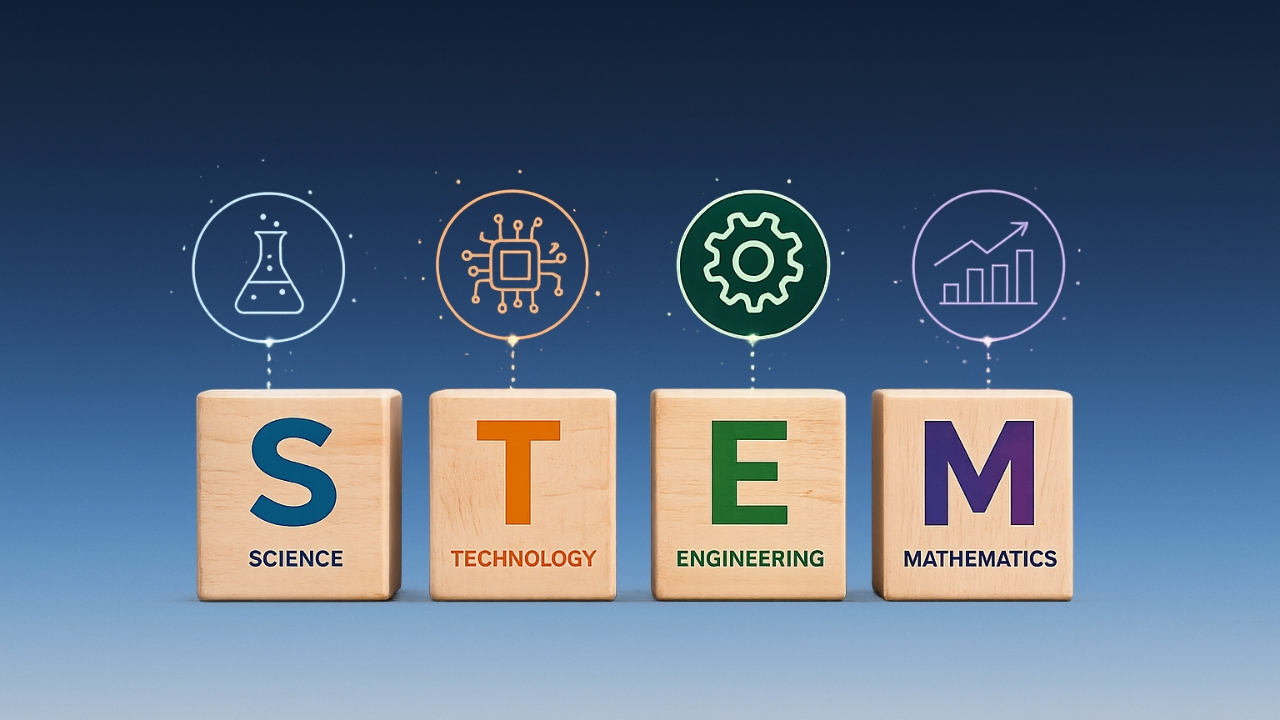
STEM skills have moved far beyond engineering labs, software teams, and research departments. In modern business, leaders now need enough technical fluency to question dashboards, evaluate automation, judge AI output, read basic data patterns, and speak with technical teams without losing the thread.
A finance manager may need to assess a machine-learning forecast. A marketing director may need to challenge attribution data. A retail owner may need to compare inventory software, payment systems, cybersecurity risks, and customer analytics.
None of those jobs requires becoming a scientist or programmer. They do require a working grasp of how numbers, systems, evidence, and technology shape decisions.
That is why STEM literacy is becoming a business skill, much like budgeting, negotiation, or clear writing.
STEM Literacy Now Means Business Judgment
STEM literacy in business does not mean every employee must write Python code or build a statistical model from scratch. It means being able to think clearly about evidence, systems, and uncertainty.
- Reading charts without being misled by averages or weak samples
- Asking what data was collected, what was excluded, and why
- Knowing when automation can help and when human review matters
- Recognizing cybersecurity and privacy risks before they become expensive problems
- Translating technical work into business decisions
The National Academies has argued that STEM education supports decision-making beyond specialist careers, because it builds evidence-based reasoning and problem-solving habits.
That point matters for business, where leaders often make high-cost decisions with incomplete information.
A company does not need every manager to become a data scientist. It does need managers who can ask better questions before approving a technology purchase, changing a pricing model, or trusting an AI-generated forecast.
Labor Data Shows Why Technical Fluency Matters
Numbers, research, and discovery: STEM employment projected to take off! https://t.co/KBmAcSYcxl #BLSdata pic.twitter.com/anCsdPvDRh
— BLS-Labor Statistics (@BLS_gov) December 10, 2025
The U.S. Bureau of Labor Statistics projects STEM employment to grow from 10.78 million jobs in 2024 to 11.65 million by 2034.
That represents 8.1% growth, compared with 3.1% for all occupations. Median annual wages for STEM occupations were $103,580 in 2024, more than double the $49,500 median for all occupations.
| Category | 2024 Employment | Projected 2034 Employment | Projected Growth | 2024 Median Annual Wage |
| All Occupations | 169.96 Million | 175.17 Million | 3.1% | $49,500 |
| STEM Occupations | 10.78 Million | 11.65 Million | 8.1% | $103,580 |
The point for business owners and employees is direct: STEM-heavy work is expanding faster than the broader labor market, and its influence reaches roles outside formal STEM job titles.
Sales teams use analytics platforms. Operations teams rely on forecasting systems. Human resources departments use workforce planning tools. Legal and compliance teams review AI, privacy, and risk controls.
The National Science Foundation’s 2026 STEM talent report also notes that the STEM workforce accounts for roughly a quarter of U.S. workers and includes both traditional science and engineering roles, plus skilled technical workers.
AI Has Raised The Baseline For Everyone
Artificial intelligence has made technical literacy feel urgent because AI tools are now entering ordinary workflows.
McKinsey’s 2025 State of AI survey found that 88% of respondents said their organizations were using AI in at least 1 business function, up from 78% the year before.
The same report found that many companies remain in experimentation or pilot stages, which means employees still need judgment, validation, and process discipline around AI use.
That matters because AI can produce fluent answers that appear credible. A manager with weak STEM literacy may accept a model output because it sounds precise. A stronger manager asks:
- What data trained or informed the output?
- Could the system be biased toward older customer behavior?
- Has anyone tested accuracy against real outcomes?
- What decision will humans still review?
AI makes STEM literacy more important because it lowers the barrier to using advanced tools while raising the risk of shallow confidence. In business, the danger often comes from people using technology without enough context to judge its limits.
Data Literacy Is Becoming A Daily Management Skill

Data literacy may be the most visible form of STEM literacy in business. Companies now collect information from websites, customer relationship systems, payment platforms, supply chains, hiring pipelines, and internal productivity tools.
Raw data rarely tells leaders what to do. People still have to decide whether the data is clean, relevant, timely, and meaningful.
A restaurant owner comparing delivery app performance needs to separate order volume from profit margin.
A retailer reviewing online ads needs to know that a high click-through rate can still produce weak sales. A manufacturer looking at defect rates needs to ask whether a spike reflects worse production or better reporting.
Basic statistical thinking can prevent expensive mistakes. For example, a business might celebrate a 20% jump in sales after launching a new campaign.
If the same week included a holiday, a price cut, or a competitor outage, the campaign may deserve less credit than it appears. STEM literacy helps leaders slow down before turning coincidence into strategy.
Technology Decisions Are Now Business Decisions
Buying software used to feel like a back-office decision. Now it shapes customer experience, hiring, security, finance, and brand trust.
A small company choosing an e-commerce platform is making decisions about payment security, mobile speed, customer data, search visibility, inventory synchronization, and analytics.
A hospital evaluating scheduling software must think about privacy, reliability, patient access, and staff workflow. A bank reviewing AI tools has to weigh fraud detection, explainability, compliance, and cyber exposure.
View this post on Instagram
The World Economic Forum’s Future of Jobs Report 2025 identified AI and big data as the fastest-growing skills, followed by networks, cybersecurity, and technology literacy. It also listed creative thinking, resilience, curiosity, and lifelong learning as rising skills for the 2025 to 2030 period.
That mix is important. Businesses need people who can work with technology, but also people who can interpret, challenge, and communicate what technology produces.
STEM Skills Help Nontechnical Teams Work Better

One of the most practical benefits of STEM literacy is better collaboration. Many business failures happen between departments, not inside one department.
A product team asks for a feature without explaining the business case. A technical team builds the feature but misses the customer problem. A finance team rejects a tool because the short-term cost looks high, while ignoring long-term efficiency.
STEM-literate business employees can act as translators. They may not code, but they can explain the operational goal, ask realistic questions, and spot weak assumptions.
In Marketing
Marketers now work with attribution models, A/B tests, search data, personalization tools, and AI-generated content.
STEM literacy helps them avoid reading every metric as proof. A campaign may increase traffic while attracting the wrong audience. A test may look successful because the sample was too small.
In Finance
Finance teams rely on forecasting, scenario modeling, fraud detection, and automated reporting.
A finance leader with stronger technical fluency can question the assumptions behind a model before using it to guide hiring, pricing, or investment.
In Operations
Operations teams use sensors, logistics platforms, demand forecasts, and quality-control data. STEM habits help teams identify bottlenecks, measure process changes, and avoid guessing when a pattern can be tested.
The New Business Literacy Has 4 Core Parts
STEM literacy becomes less intimidating when broken into practical abilities.
| Skill Area | What It Means In Business | Example |
| Data Reasoning | Reading numbers with context | Spotting weak survey data before changing a product |
| Systems Thinking | Seeing how one change affects another | Knowing a faster checkout system may affect fraud controls |
| Technical Communication | Speaking clearly with technical teams | Explaining a business goal behind a software request |
| Evidence-Based Decision-Making | Testing claims before acting | Running a small pilot before a full rollout |
None of those skills requires advanced degrees. They require curiosity, discipline, and enough technical vocabulary to avoid blind spots.
Education And Training Need To Catch Up

The NSF has warned that access to STEM training varies across schools, districts, and regions, often linked to socioeconomic and geographic factors. Its 2026 report also points to gaps in foundational math recovery after the pandemic, especially among students who are not yet back to pre-pandemic performance levels.
For employers, that creates a training challenge. Hiring only technical specialists will not be enough. Companies need broader internal learning: short courses in data interpretation, AI use policies, cybersecurity basics, spreadsheet modeling, and process measurement.
Good training should feel practical. Practical STEM learning also benefits from accessible problem-solving resources, and platforms such as Qui Si Risolve show how theory and worked examples can help learners connect abstract math or physics concepts with real reasoning habits.
Summary
@thelazydeveloper Entrepreneurial skills, STEM skills, we are weak in these areas going forward. According to @PwC Singapore ♬ original sound – thelazydeveloper
STEM skills are becoming the new business literacy because modern work runs on data, software, automation, and technical judgment.
The real advantage belongs to people who can connect evidence with decisions. Business leaders do not need to turn every employee into an engineer.
They need teams that can ask sharper questions, use tools responsibly, and make decisions with a clearer view of how technology actually works.